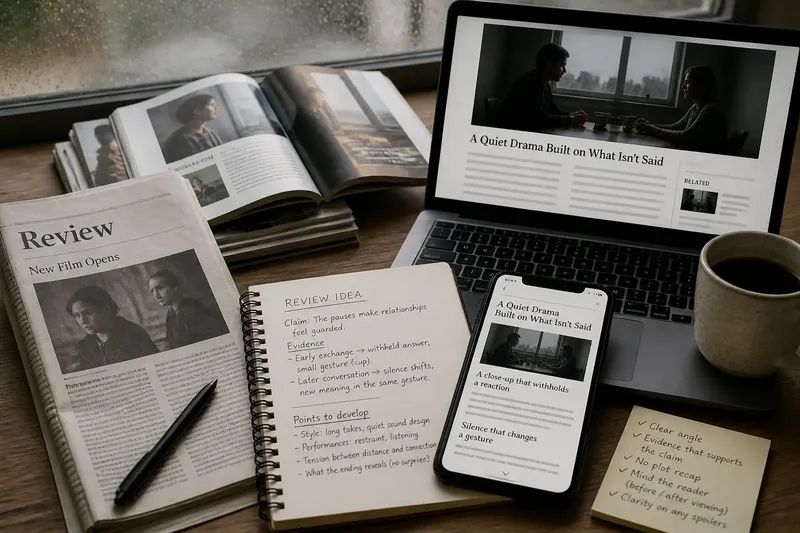
The Review Thesis: One Claim to Hold the Pieces Together
A review thesis turns scattered reactions into a clear claim, helping you choose evidence and give readers a precise way to understand your judgment.
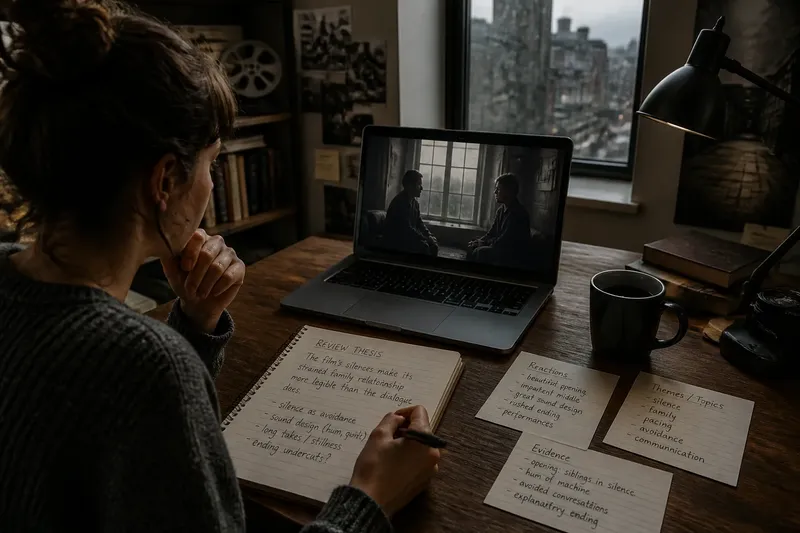
When a film leaves you with a dozen reactions, a review thesis helps you decide which ones belong together. A strong review thesis is one arguable claim about what the film does and why that matters—not a verdict such as “it was good” or a list of everything you noticed.
Think of the thesis as the handle on a full grocery bag: it gives the reader something firm to hold while the details inside shift. Use these steps to find a claim that can guide the review without flattening the film.
1. Separate your reactions before choosing a claim
Write down your immediate responses without trying to make them agree. You might admire a lead performance, feel impatient with the middle, enjoy the sound design, and dislike the final scene. That mixture is useful raw material, not yet an argument.
Next, sort the reactions by what they seem to describe: the film’s pacing, point of view, character relationships, visual choices, or emotional effect. Look for a connection, but do not force one. If your notes point in genuinely different directions, the review may need to focus on one tension rather than pretend the film has a single, tidy effect.
Say you leave an invented science-fiction drama impressed by its quiet opening but frustrated by a rushed ending. You also notice that its strongest scenes let the characters avoid saying what they mean. Those reactions might connect through the film’s use of silence, giving you a more specific starting point than “the pacing is uneven.”
2. Turn a topic into an arguable sentence
A topic names what the review is about: the acting, the ending, or the film’s use of silence. A thesis makes a claim about that topic. “The film uses silence” is a description; “The film’s silences make its strained family relationship more legible than the dialogue does” is an interpretation a reader can consider and contest.
Try completing this sentence: “The film’s use of ___ makes ___ feel ___.” The blanks are prompts, not a formula you must keep. Replace them with language that captures the relationship you actually observed, and remove claims that merely announce your preference.
A useful claim usually says something about both craft and effect. It gives you room to discuss concrete choices while explaining why they shape a viewer’s experience. It also keeps the review from turning into a collection of unrelated likes and dislikes.
3. Make the claim narrow enough to support
Broad claims are difficult to defend because they ask one review to account for a whole film. “The direction is brilliant” could refer to nearly anything; “the long, fixed shots make the apartment feel like a place the characters cannot leave” points toward specific evidence and an effect worth examining.
To narrow a draft thesis, ask which part of the film you can actually discuss: a recurring visual pattern, a performance choice, a contrast between scenes, or a decision in the sound mix. Then ask what that feature contributes. Keep the claim focused on the relationship you can explain, rather than stretching it into a judgment about every part of the film.
Specificity does not require a fussy argument. A compact claim can still be substantial if it connects an observable choice to an interpretive consequence. The reader should be able to tell what you think the film is doing, not just whether you enjoyed watching it.
4. Let evidence shape the wording
A thesis should grow from what appears on screen, not from an opinion you decided to defend before looking closely. Identify a few moments that bear on the same claim. They may support it, complicate it, or reveal where its reach ends.
In the invented science-fiction drama, perhaps the opening holds on two siblings sitting in silence after a power failure, while a later argument is covered by the hum of a machine. Those details could support a claim that the film makes avoidance audible and visible. If the ending then explains the relationship in direct dialogue, that counterexample might require a more measured thesis: the film’s strongest passages convey estrangement through what the characters withhold.
Notice how the revised claim leaves room for the ending instead of hiding it. Evidence is not decoration added after the argument; it helps determine how broadly the argument can be stated. If the moments do not support the same idea, revise the claim rather than bending every scene to fit.
5. Test whether each section serves the same question
Once you have a working thesis, use it to check your planned paragraphs. Each section should develop the claim, qualify it, or show a meaningful limit. A paragraph about costume design may belong if it helps explain the film’s view of status; it may be a detour if it only records that the clothes looked convincing.
Ask of each paragraph: “What does this help the reader understand about my claim?” If you cannot answer in a sentence, the material may need a clearer link, a different place, or a cut. This test is about relevance, not uniformity; a useful review can include disagreement within the film or within your own response.
When a detail seems important but does not support the current thesis, consider whether it points to a better central claim. Do not keep a weak thesis simply because you have already drafted around it. A review is clearer when its main idea reflects the film you actually watched.
6. Revise the claim as the review takes shape
The first thesis you write is a working version. After drafting, compare it with the evidence you chose and the conclusion you reached. If the body argues that a film’s silence creates intimacy, but the ending says it mainly produces unease, the claim may be trying to do too much or naming the wrong effect.
Read the thesis beside each major example. Look for overstatement, vague words such as “powerful,” and claims that repeat the plot instead of interpreting it. Replace them with language that states the film’s choice and the consequence you can explain.
For instance, the invented review might begin by calling the family drama “a story about silence,” then become more precise after drafting: “Its early silences make estrangement palpable, though the explanatory ending weakens that effect.” The revised sentence is arguable, specific, and honest about a limit.
Which questions help you check a review thesis?
Can a reader disagree with the thesis?
Yes. A thesis should make an interpretation another viewer could reasonably challenge, not present a taste as a fact. If the sentence only says that you liked the film, add a claim about how a choice on screen produced or complicated that response.
Does the thesis need to mention the plot?
Only when a plot element is central to the interpretation. A review thesis can focus on performance, sound, framing, rhythm, or another formal choice, as long as the claim remains clear to someone who knows the film.
What if the film feels inconsistent?
Make the inconsistency part of the claim if it matters to your judgment. You might argue that a film’s restrained first half makes its abrupt change in tone feel unearned, then use specific scenes to explain the shift rather than smoothing it away.
How can I tell if the thesis is too broad?
If you need to mention many unrelated elements to support it, narrow the claim to the feature that best explains your response. A focused thesis can acknowledge other strengths or weaknesses without claiming to account for every part of the film.
7. Keep the thesis visible without repeating it
State the central claim early enough to orient the reader, then let the review develop it through examples and reasoning. You do not need to restate the same sentence in every section. Instead, use each paragraph to add a consequence, complication, or qualification that the opening claim makes meaningful.
Near the end, return to the judgment the evidence supports. A strong review thesis does not promise that every viewer will respond the same way; it shows how particular filmmaking choices led you to a defensible reading. That gives readers a clear basis for deciding whether the film’s choices might matter to them, too.