Scene Detail or Plot Summary: Choosing What to Include in a Film Review
Scene detail or plot summary: learn to trim recap, choose useful scene evidence, and make your film review’s claims clear without giving away more than needed.

When a film review turns into a list of events, readers may know what happened but still not know why the movie worked—or failed. Scene detail or plot summary is a choice about emphasis: give just enough story for readers to follow your point, then show the moment that supports it.
How much plot context does a scene need?
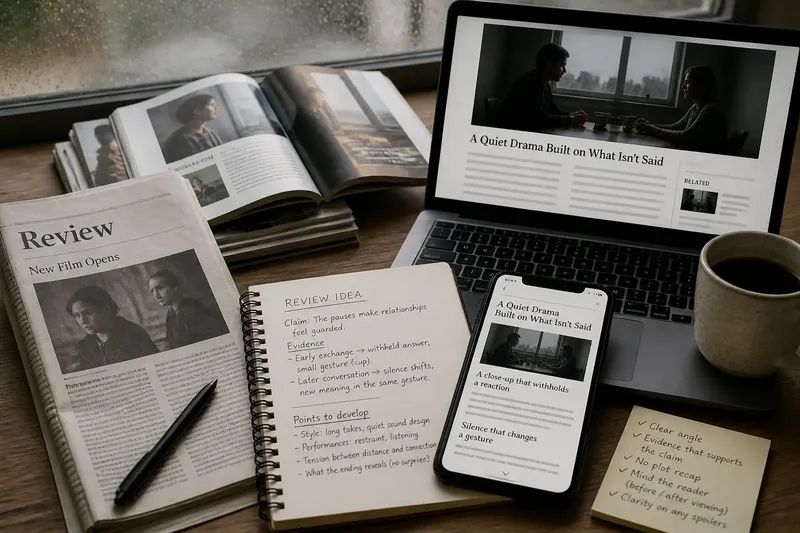
Start with the claim you want to make, then keep only the story information a reader needs to understand its evidence. A sentence about a character’s goal or relationship may be enough; a scene-by-scene retelling usually delays the review’s judgment.
Imagine an invented film, Low Tide, about two siblings deciding whether to sell their late father’s boat shop. One claims the shop is an unwanted burden; the other has quietly been repairing a boat. If your point is that the film treats grief through shared labor, readers need that conflict, but not every visit to the shop.
Use plot recap as a door label: it helps readers find the relevant room. The scene itself is what they need to inspect. If a plot detail does not clarify the scene, the character’s choice, or your claim, cut it.
What makes a scene useful evidence?
Evidence is an observable choice in the film, not a general description of its subject. Look for a character’s pause, a change in blocking, a camera position, an edit, a recurring sound, or an object that gains meaning through the scene.
In the invented Low Tide, the siblings argue across a workbench, each holding a different part of the same half-repaired boat. The camera keeps both in a wide frame, and a fluorescent light buzzes through their silences. Those details let a reviewer explain how the staging holds the siblings together physically while the sound and pauses keep the conflict subdued.
Connect the observation to your interpretation in plain language: “The shared frame makes their dispute feel like a problem they still have to handle together.” That sentence does more than name a camera technique; it tells readers why the choice matters to your judgment.
How do you decide what to keep in a review?
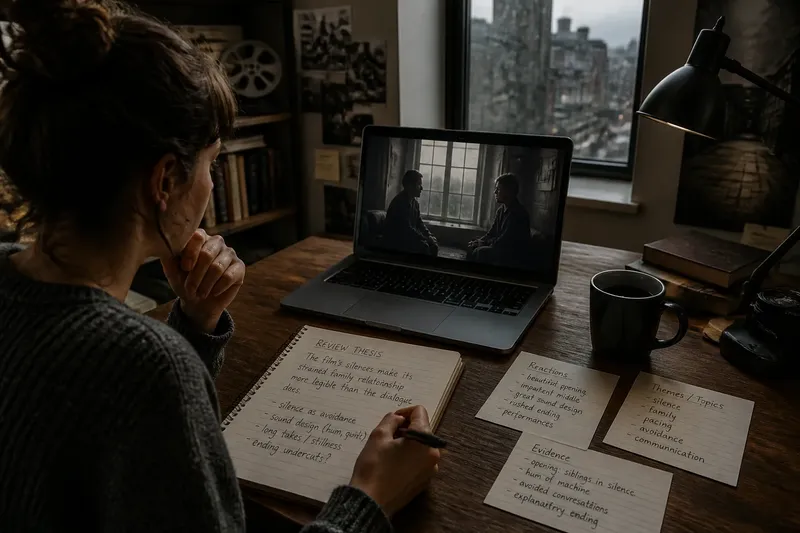
Before drafting, sort your notes by the job each detail can do. Keep a plot event if it gives necessary context; keep a scene observation if it supports or complicates your claim. Use this checklist to make the decision:
- Check whether the event explains the character’s goal; if it does, keep the shortest clear setup, and if it does not, remove it.
- Check whether a reader can picture the scene detail; if you can name an action, sound, image, or edit, use it, and if you have only a vague impression, revisit your notes or leave it out.
- Check whether the detail supports your claim; if you can explain the connection, include that explanation, and if the link is unclear, choose another detail or revise the claim.
- Check whether a second example adds a different point; if it confirms or complicates the first, include it, and if it merely repeats the same effect, keep the stronger one.
- Check whether the passage reveals a consequential turn; if the turn is essential, warn readers before describing it, and if it is not essential, use an earlier scene instead.
- Check whether recap takes more space than the analysis; if it does, cut events that do not prepare the evidence, and if the context is already lean, preserve it.
How can you turn notes into an evidence-led paragraph?
Say you have these invented notes about Low Tide: “The daughter opens the repair ledger; sees her father’s last entry; stops; the camera stays on the book.” Your claim is that the film makes grief visible through work rather than a speech. Keep the relevant action and the film’s choice, then state how they connect.
A focused passage could read: “When Mara reaches her father’s final repair entry, she stops turning pages. The camera holds on the ledger instead of cutting to a speech, letting an ordinary work record carry the force of her loss. The scene makes the shop feel less like property to sell than a practice she may choose to continue.”
The passage begins with enough plot to orient readers, identifies a specific choice, and explains the interpretation. If your draft instead recounts the argument, the ledger’s discovery, and the decision about the shop, retain only the events needed to understand this moment.
When should a review include a spoiler?
A plot detail becomes a spoiler when revealing it could change a reader’s experience of the film. Include a major turn only when your argument depends on it, and place a clear warning before the disclosure. Avoid hints that nearly reveal the outcome while leaving readers unable to follow your point.
If the review is helping someone decide whether to watch, you can often discuss the film’s technique without naming a late revelation. Describe how a scene is framed or performed, but do not disguise a crucial plot fact as a vague tease.
What questions come up about plot and scene evidence?
How much plot should a film review recap?
Include the events needed to understand your claim and its evidence. If an event does not clarify a character’s choice or the scene under discussion, it can usually go.
Can one scene support a whole review?
One scene can anchor a focused point, but a broad judgment needs support beyond a single moment. Add another scene when it changes, tests, or complicates your reading rather than repeating the same evidence.
What counts as a specific scene detail?
Name something a viewer could notice: a pause, a camera position, a repeated sound, a cut, or a character’s movement through the frame. Then explain what that choice does for the scene or your argument.
Should a review describe the ending?
Describe the ending only when it is necessary to your argument, and warn readers before revealing a consequential turn. If an earlier scene supports the same point, use it instead.
How can you keep plot summary in its proper role?
Use a final pass to mark each sentence as context, observation, or interpretation. If context dominates, remove events that do not prepare the scene; if observations pile up without interpretation, explain what they contribute to your judgment.
Scene detail or plot summary does not require an either-or answer. Keep the plot lean enough to orient readers, then give the film’s choices room to support your reading.