How Movie Reviews Changed from Newspaper Columns to Online Reading
Learn how print and online formats shape movie reviews, then choose a structure that fits your publication, screen, reader, and argument without losing clarity.
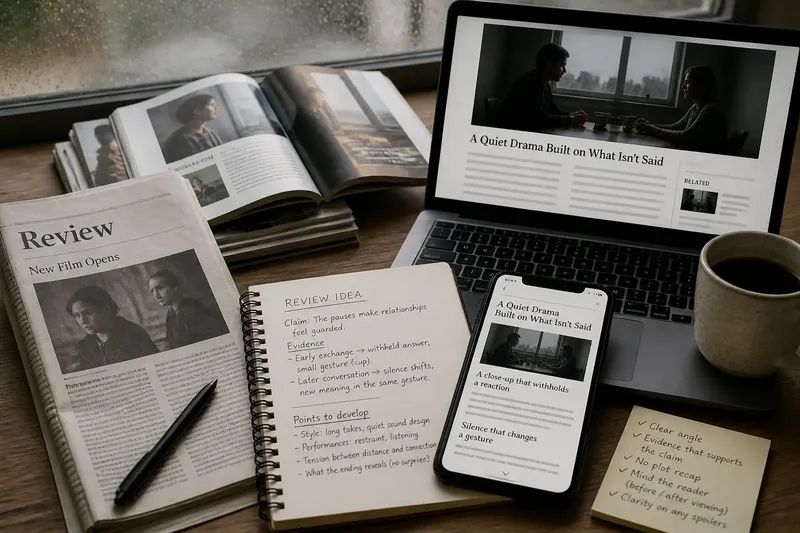
When a newspaper review was cut to fit a column, the critic had to decide which scene could carry the judgment; an online editor can give that argument more room, but must also make it easy to scan on a phone. Movie reviews have changed from newspaper columns to online reading in their layout and distribution, while the critic’s practical problem remains: how to make the film’s choices legible to a reader.
What did a newspaper column ask of a movie review?
A newspaper review occupied a physical page alongside other material. Its available space depended on the publication’s layout, so editors and critics had to decide how much room a particular film deserved. A short column could still make a specific case, but it had little room for a scene-by-scene account.
The column also had to work for readers who encountered it while browsing the paper, rather than seeking out a long essay on that film. A critic could identify the film, state a judgment, and choose a detail that showed how the acting, direction, or editing produced an effect. The constraint was not simply brevity; it was selecting evidence that could do more than one job.
For example, a description of a held close-up might establish the film’s visual approach and support a claim about a performance at once. Listing several unrelated plot events would use space without necessarily clarifying the review’s point. The same choice matters in longer formats, but a column makes the tradeoff especially visible.
How did magazine layouts make room for different kinds of criticism?
A magazine could devote more page space to a review or surround it with photographs, captions, and related material. That gave editors options: extend the critic’s discussion, or move background information into a sidebar or separate feature. The layout could suggest connections between a film and its production, genre, or performers, but those elements did not all serve the same purpose.
A review evaluates what the finished film does. A profile focuses on a person; a production feature explains how a film was made. Keeping those forms distinct helps a reader understand whether a paragraph is making a critical claim or supplying context.
Images offered another editorial choice. A still could direct attention to a composition or gesture, but the critic still needed to explain why it mattered. If the argument depends on a contrast between two scenes, the prose should describe that contrast rather than assume a page image will make it clear.
What did online publication change for movie reviews?
Online publication freed a review from a single printed page and made linking to related coverage possible. It also changed how readers might arrive: through a search result, a shared link, or another story. A clear headline and opening help a reader identify the film and the review’s angle without needing to follow links first.
Links can point to a director’s earlier work, a related interview, or a publication’s explanation of its rating system. They should add context, not hold essential reasoning hostage. The review itself still needs to explain how its evidence supports its judgment.
Online readers may also be at different points: one might be deciding whether to watch the film, while another has already seen it and wants a closer reading. Use plot details only when they support the criticism, and make any discussion of a major turn clear before the reader reaches it. A screen gives editors ways to separate spoiler-heavy material, but separation is not a reason to include details the argument does not need.
Does online reading always call for shorter reviews?
No. A short review can explain a focused response; a longer piece can develop an argument that needs more than one kind of evidence. Length should follow the work the review has to do, not a blanket rule about screens.
Think of the structure like a tray: each section should have a place and a purpose, rather than piling every observation together. If two paragraphs make the same point about a film’s slow pace, combine them or use the second to show a different consequence. If the film’s style and performances pull in opposing directions, a longer discussion may help readers see the tension.
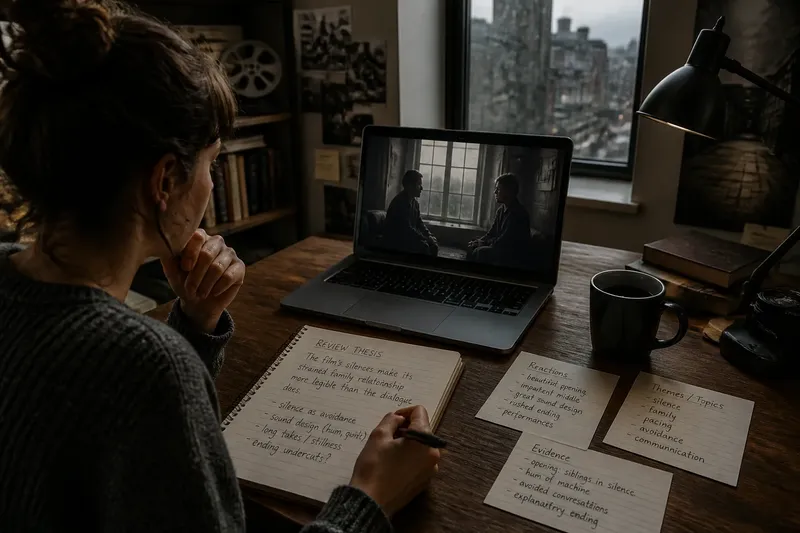
Before drafting, write the claim you want the reader to understand and list the scenes or formal choices that can support it. Keep an example only if it advances the claim, adds a useful contrast, or reveals a complication. That test helps a short piece avoid vagueness and a long piece avoid repetition.
How should a review work across print and phone screens?
Give the review a clear path: an opening that establishes its angle, sections that develop distinct points, and transitions that show how the evidence connects. On a narrow screen, short paragraphs and descriptive subheadings make the argument easier to scan. In print, the review should remain understandable if images or sidebars are placed nearby.
Say you are reviewing an invented quiet drama whose scenes often pause before a character answers. You decide the pauses make the relationships feel guarded, then select one early exchange and one later conversation where the silence changes the meaning of a gesture. You write those moments into separate paragraphs, explaining the shift in each; the observable result is that a reader can follow the claim from the first example to the second without needing a plot recap.
Captions should identify what a still shows, not smuggle in an argument the review has not made. Subheadings should name the discussion that follows, such as “A close-up that withholds a reaction,” rather than tease a revelation or repeat a verdict. These choices help the same critical reasoning survive changes in layout.
What do writers ask about movie review formats?
How long should a movie review be?
Write until the judgment has useful support and the main complications are clear, then remove material that repeats the case without developing it. The publication’s format may set boundaries, but the reader should not have to work through padding to find the point.
Should every movie review include a rating?
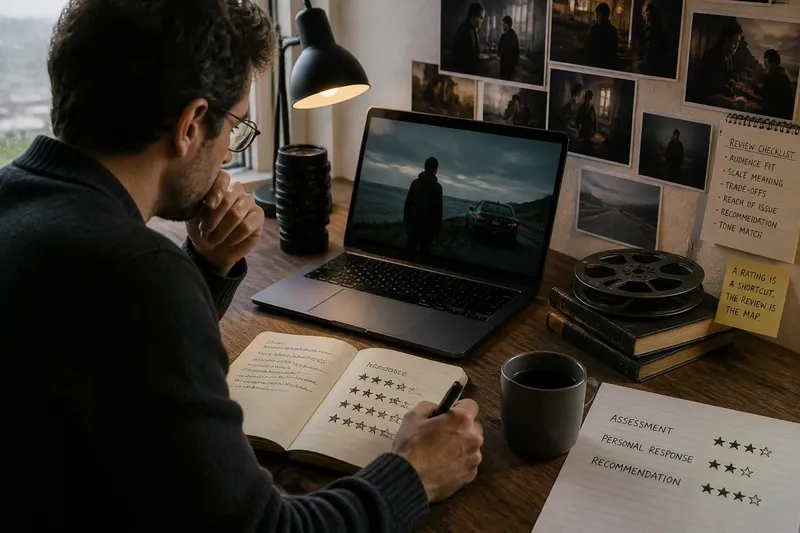
No. Use a rating when the publication’s system is clear and useful to its readers, and explain the judgment in prose either way. If the scale is unfamiliar, a direct account of the film’s strengths and limits is more informative than an unexplained symbol.
How can a review avoid spoilers?
Describe the scene or choice that supports the criticism while withholding major developments that are not necessary to the argument. If a spoiler is essential, warn readers before it appears and explain why the detail matters.
Can one movie review work in print and online?
Often, if its argument does not depend on a specific layout and its sections remain clear when read in sequence. Editors can adapt headings, images, and spacing for different formats without changing the critic’s reasoning.
Which parts of a movie review should stay flexible?
The opening, sequence of points, use of images, and amount of context can all change with the film and publication. A review centered on visual design might begin with a composition; one centered on an actor’s performance might open with a choice made in a key scene. The structure should make the critic’s reasoning easier to follow, not imitate a format for its own sake.
When choosing a format for a movie review, start with the reader’s likely question and the evidence that answers it. Then decide what the page, screen, or publication can support: a compressed argument, a more extended analysis, or a review accompanied by separate context. The format is doing its job when readers can see both what you think and what in the film led you there.