A Review of a Film You Love: Keeping Admiration Specific
Review a film you love by separating personal memories from its on-screen choices, so readers can understand what makes its pleasures distinct.
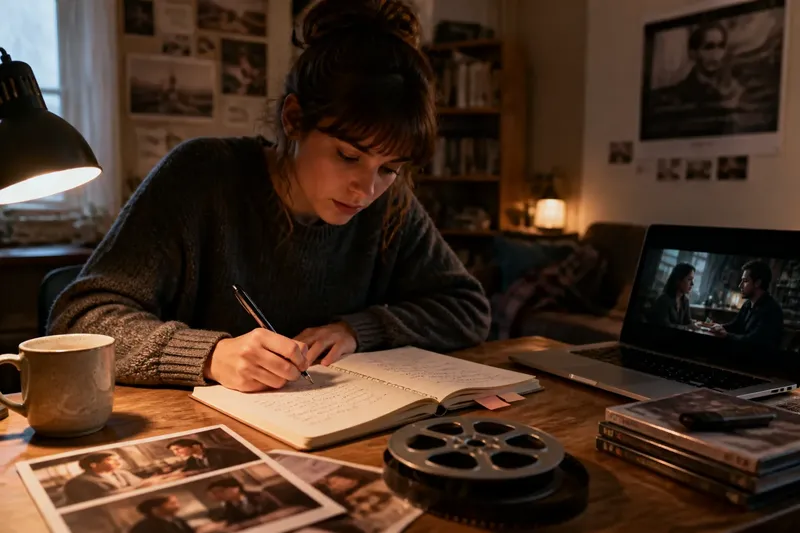
How do you review a film you love without turning the review into a memory scrapbook? Start with the film review itself: separate what the movie means in your life from the choices that make its pleasures visible to another viewer.
What does a repeat viewing add to a film review?
A favorite film can arrive tangled with its setting in your life: a relative’s living room, a first date, or a difficult season. That history belongs to your response, but a reader needs more than the story of how you encountered the movie. A repeat viewing gives you room to distinguish the film’s effect from the associations that gather around it.
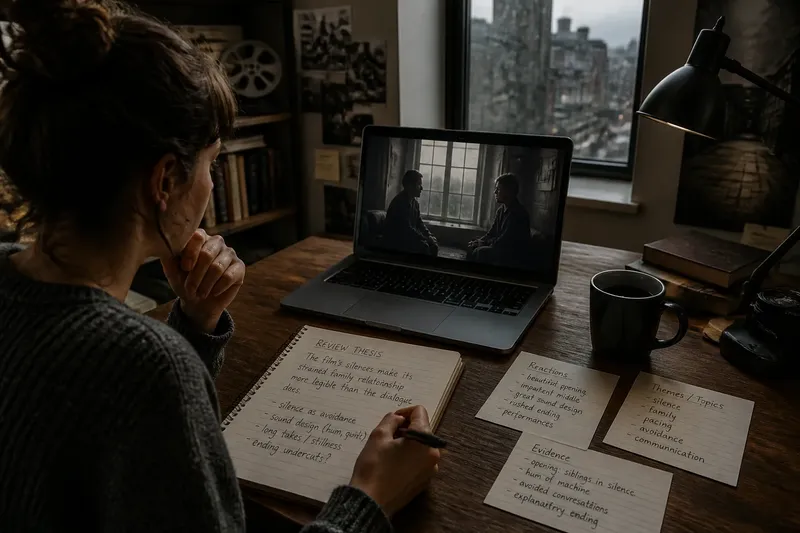
Give each viewing a different job. Watch once for your immediate reaction, return while following one craft element, then revisit scenes you plan to describe. A notebook or notes app is enough; record brief cues rather than a complete account of every scene.
What should you write down after the first viewing?
Watch straight through without pausing. When the credits begin, note the moment that lingers, the feeling it left, and any personal association that surfaced. Keep those in separate lines so that memory does not quietly become a claim about the movie.
For example, “I watched this with my older cousin” explains your history. “The final exchange makes affection sound awkward rather than polished” points to an effect another viewer can listen for. Both statements may belong in a review, but only the second describes the film’s choices.
Say you love a comedy because you watched it often during a quiet winter at home. After the first viewing, you write down that one character’s hesitant pauses feel warm and familiar. On the next pass, you notice that quick cuts to other characters’ restrained reactions follow those pauses; you can describe how the editing makes the awkwardness funny while leaving the tenderness intact.
How can you choose details that fit your admiration?
On the next viewing, follow one element tied to the moment you noted: performance, framing, editing, sound, production design, or dialogue. The aim is not to catalogue technique. Ask what the element does to the scene and whether it helps explain your particular response.
- Performance: If an actor’s pause or interrupted line changes how a moment feels, describe that behavior; if it does not, choose a more revealing detail.
- Framing: If the composition leaves characters isolated or presses them together, explain how that arrangement affects the scene; if it adds no useful meaning, focus elsewhere.
- Editing: If a cut changes a joke’s timing or connects images in a surprising way, name the cut’s effect; if the sequence works for another reason, follow that instead.
- Sound: If music, silence, or room noise complicates the emotion, describe the contrast; if sound simply repeats what the image already conveys, look for a more distinctive choice.
- Dialogue: If repeated words or evasions show how characters relate, point to the pattern; if the wording is incidental, do not force it into your account.
- Production design: If a room, object, or costume changes how you read a character, identify the detail; if it is only background, leave it out.
Each item asks you to make a decision, not collect praise. “The performances are wonderful” gives readers no scene to imagine. “The lead answers a simple question with a joke, then drops the grin when nobody laughs” shows a behavior and gives you room to explain how charm and discomfort share the moment.
What should you verify before describing a scene?
Return to the scenes you plan to discuss and check what happens around the detail you remember. A moment you recalled as a close-up may be a two-shot; a line that seemed spontaneous may be followed by a deliberate silence. Confirming the sequence helps you describe the film that is on screen rather than the version affection has kept in your head.
Check for variation as well as accuracy. If music rises at several emotional turns, consider whether it deepens the feeling each time, announces what the image already communicates, or does both in different scenes. A limit can clarify your praise: the score may be moving in one sequence and too insistent in another.
Think of a favorite as a recipe card with a few ingredients smudged. Your affection tells you the dish mattered; looking again helps you identify what is actually there.
How can you keep a film review routine manageable?
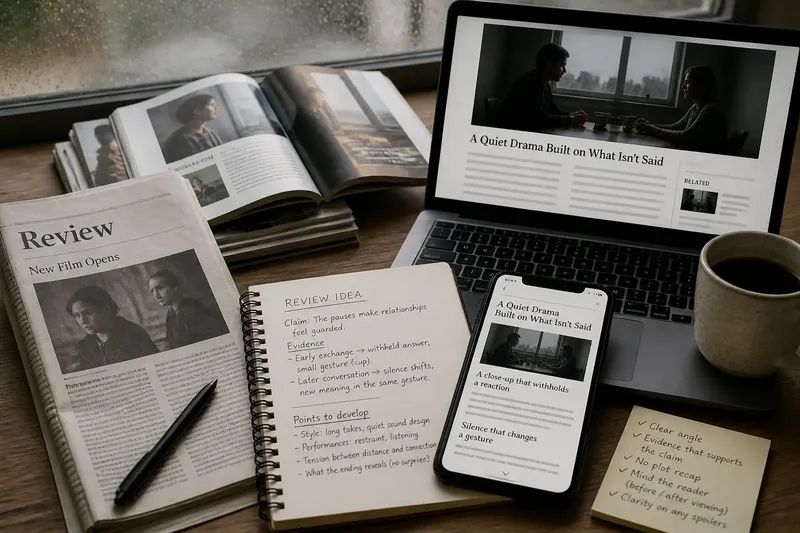
Use a short sequence that gives each pass a clear purpose. For the invented situation above, the notes might look like this:
- First viewing: Start with the comedy, watch without pausing, and write “hesitant pauses feel warm” plus “quiet winter with cousin” as separate notes. The result is one personal association and one reaction to examine.
- Afterward: Circle the scene containing the pauses. If that moment best explains the affection, keep it as your focus; if another scene lingers more strongly, choose that one instead.
- Second viewing: Track editing in the circled scene and note that the film cuts to restrained reactions after the pauses. If the cuts shape the joke, use them in the review; if they do not, return to the performance or another element.
- Scene check: Replay the passage and confirm the order: pause, cut, reaction. If the remembered order is correct, describe it; if not, revise the note before drafting.
- Drafting: Pair the verified sequence with your response: the cuts make the awkwardness funny without erasing warmth. If that sentence explains your admiration, retain it; if it only retells the action, add the effect or choose a more useful observation.
If a full repeat viewing is not practical, revisit selected scenes and mark which details you have not checked. The point is not to turn pleasure into homework; it is to leave yourself enough reliable material to say more than “I love this.”
What questions help you write about a favorite film?
How much personal history belongs in a film review?
Include a brief memory when it explains why the film matters to you, then distinguish it from the on-screen detail that supports your description. Your history accounts for the connection; it cannot stand in for what happens in the scene.
Can a favorite film still have flaws?
Yes. Mention a limitation when it helps readers understand the experience, such as a joke that repeats after its surprise fades or a sentimental cue that feels too insistent. Then explain what continues to work for you without treating affection as an excuse.
What if the reason you love a film is hard to explain?
Begin with something you can point to or hear: a glance, pause, change in lighting, or shift in room tone. Describe what comes before and after it, then say what effect it has on you.
How can you praise a scene without making it sound perfect?
Describe the choice and its effect instead of issuing a verdict. Explain how a delayed reaction, spare music, or careful framing makes a particular feeling land for you, and leave room for the scene’s limits.
How do you finish a review of a film you love?
Choose the few details that best explain your admiration and cut the rest. During revision, look for broad words such as “beautiful,” “moving,” or “brilliant.” Keep them when the surrounding sentence shows what earned them; otherwise, replace them with the action, sound, or image that prompted the praise.
A useful film review lets a reader picture a pleasure without needing to share your history. Keep the scene detail that makes your response legible, and leave out the memory that cannot help them see what the film is doing.